# How does it work?

Contango builds positions by automating [looping](/basics/what-is-looping.md) strategies, through [flash loans](/resources/glossary.md#flash-loan).

When a trader opens a long ETH/DAI position with DAI as margin, the protocol gets the remaining DAI from a flash loan, swaps all DAI for ETH on the spot market, and lends ETH on a money market, to borrow DAI and repay the flash loan.

<div align="center" data-full-width="false"><figure><img src="/files/JURBOei43p4NI8MX4JhE" alt=""><figcaption><p>High level explanation of how Contango synthetizes a long ETH/DAI position</p></figcaption></figure></div>

When closing a position, Contango simply undoes the above steps.

Please note that currently Contango has integrated with [*variable-rate* markets](/resources/glossary.md#money-market) (which does not necessarily close the door to integrations with *fixed-rate* markets too).

Below is a detailed explanation how Contango builds long and short positions.

The following sub-section examines in detail a [real transaction](/basics/how-does-it-work/detailed-tx-analysis.md).

### Long position

#### Quote currency as margin

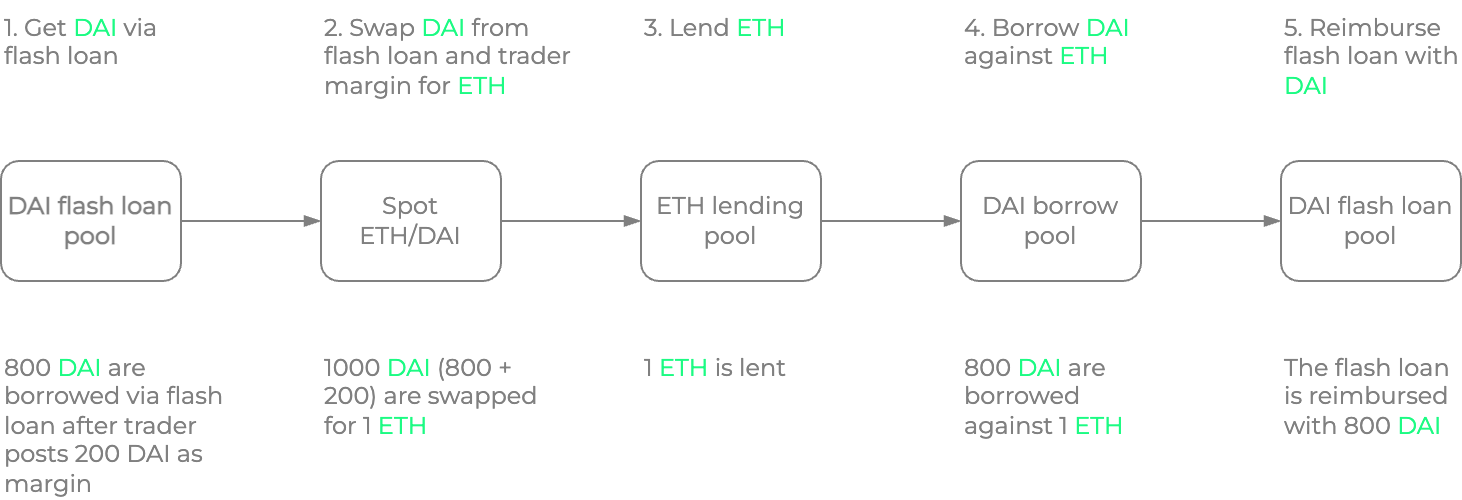
If a trader wants to long ETH with some DAI as margin, Contango will first obtain the remaining DAI with a flash loan, swap all DAI for ETH, lend that ETH on a variable rate market, and borrow DAI against it to reimburses the initial flash loan.

The diagram below recaps these steps and provides a numerical example when a trader longs 1 ETH with 200 DAI as margin, and spot ETH = 1000 DAI.

<figure><img src="/files/5qY5Oq6XVXl7kPcwXudN" alt=""><figcaption><p>Steps carried out to open a long ETH/DAI position, with DAI as margin</p></figcaption></figure>

#### Base currency as margin

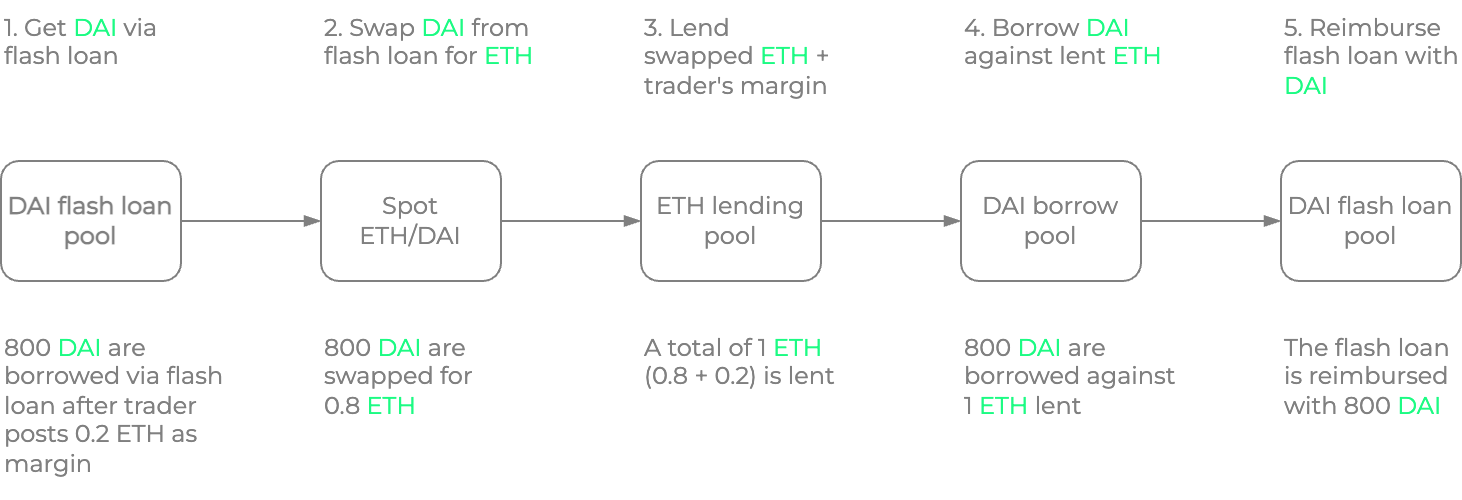
If a trader wants to long ETH with some ETH as margin, Contango will first obtain DAI with a flash loan, swap DAI for ETH, lend that ETH + the ETH posted as margin, and borrow DAI against it to reimburses the initial flash loan.

The diagram below recaps these steps and provides a numerical example when a trader longs 1 ETH with 0.2 ETH as margin, and spot ETH = 1000 DAI.

<figure><img src="/files/54WbxuWV1eYHWLzehHGY" alt=""><figcaption><p>Steps carried out to open a long ETH/DAI position, with ETH as margin</p></figcaption></figure>

### Short position

Short are built slightly different from the above flow.

* Effectively, shorts are longs on the inverse contract with a +1 on the leverage. For instance, a 2x ETH/DAI short is like a 3x long on the inverse DAI/ETH contract. This is because you need the full notional exposure on the asset you're shorting for your PnL to be coherent.
* A consequence of this is that you always have a liquidation price on Contango, even at 1x leverage.

#### Quote currency as margin

If a trader wants to short ETH with some DAI as margin, Contango will first obtain the full ETH exposure with a flash loan, swap all ETH for DAI, lend that DAI on a variable rate market, and borrow ETH against it to reimburses the initial flash loan.

The diagram below recaps these steps and provides a numerical example when a trader shorts 1 ETH with 200 DAI as margin, and spot ETH = 1000 DAI.

<figure><img src="/files/NKGvKcHzFmr2q0UeKpVs" alt=""><figcaption><p>Steps carried out to open a short ETH/DAI position, with DAI as margin</p></figcaption></figure>

#### Base currency as margin

If a trader wants to short ETH with some ETH as margin, Contango will first obtain the full ETH exposure with a flash loan, swap all ETH for DAI, lend that DAI on a variable rate market, and borrow ETH against it to reimburses the initial flash loan.

The diagram below recaps these steps and provides a numerical example when a trader shorts 1 ETH with 0.2 ETH as margin, and spot ETH = 1000 DAI.

<figure><img src="/files/pHeCGfd72yAsXDLTQOMG" alt=""><figcaption><p>Steps carried out to open a short ETH/DAI position, with ETH as margin</p></figcaption></figure>


---

# Agent Instructions: Querying This Documentation

If you need additional information that is not directly available in this page, you can query the documentation dynamically by asking a question.

Perform an HTTP GET request on the current page URL with the `ask` query parameter:

```
GET https://docs.contango.xyz/basics/how-does-it-work.md?ask=<question>
```

The question should be specific, self-contained, and written in natural language.
The response will contain a direct answer to the question and relevant excerpts and sources from the documentation.

Use this mechanism when the answer is not explicitly present in the current page, you need clarification or additional context, or you want to retrieve related documentation sections.